


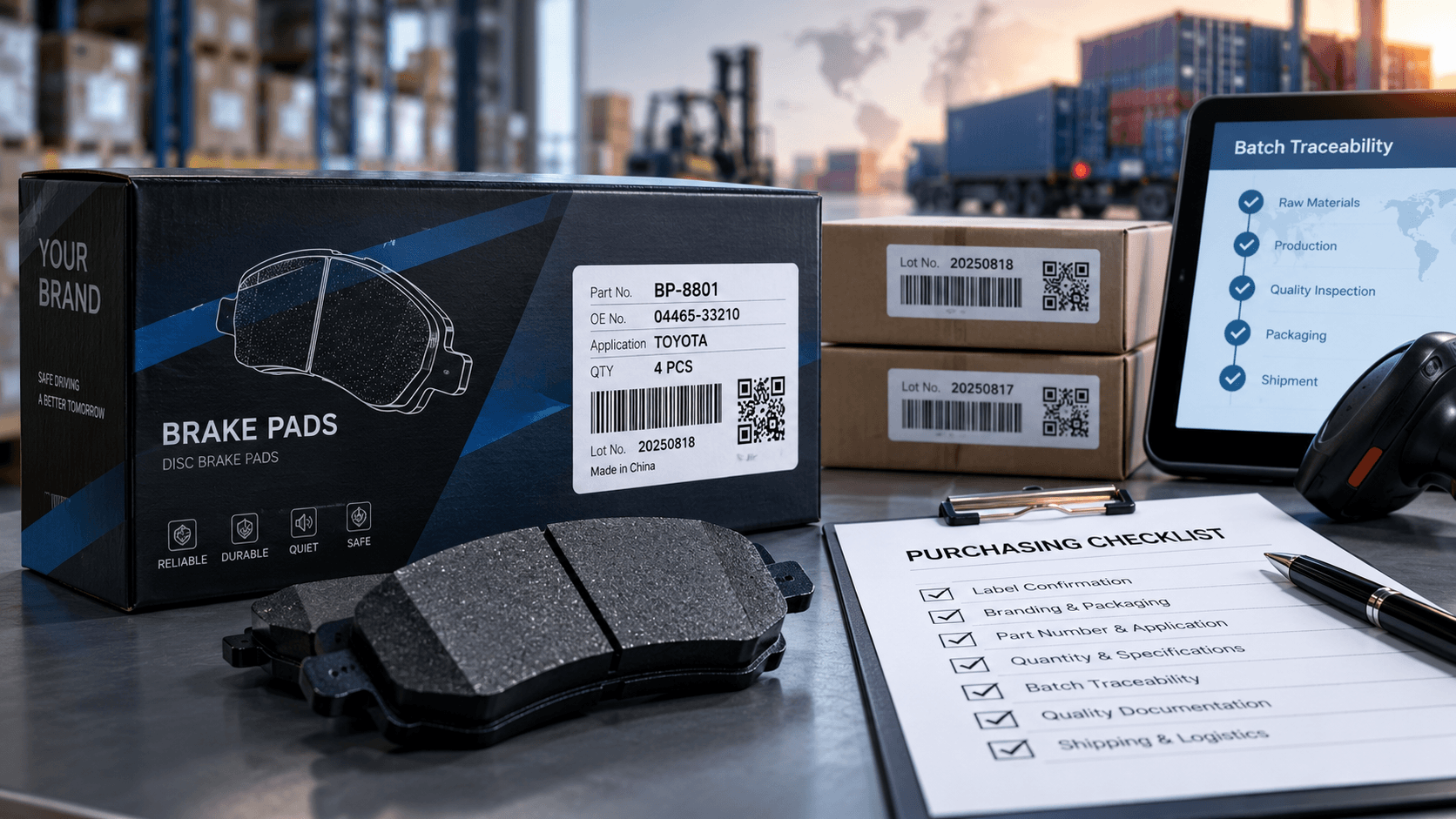
When sending an OEM or private label inquiry to Chinese brake pad manufacturers, providing only a part number and a target price often isn’t sufficient to obtain comparable quotes. Purchasers can first organize details such as pad type, target market, performance requirements, order quantity, and packaging needs into a single list. The following are suggestions for procurement communication and do not constitute universal compliance standards or product suitability guarantees.
1. Each row corresponds to a specific pad type
List the customer’s part number, known FMSI code, OE cross-reference number, installation location, and reference drawings. FMSI is a commonly used numbering system for braking friction products, but it cannot replace confirmation of dimensions, accessories, and vehicle configurations. Mark unconfirmed information as “Pending verification” — do not assume interchangeability based on similar appearances.
Reference table fields can include: customer part number, FMSI, OE, front or rear wheel, width, height, thickness, unit of measurement, drawing version, whether samples are available, and items pending confirmation. Also specify the basis for dimension measurements to avoid directly comparing numbers obtained from different measurement methods.
2. Describe the target market and usage requirements
Provide the sales country or region, channel type, expected usage scenarios, and customer acceptance criteria. If specific tests, certifications, or material restrictions are required, attach the exact file names and versions so both parties can confirm the scope of application and required evidence. Do not treat a certification name as a guarantee applicable to all products and markets.
If the friction material has not yet been determined, you can outline priorities for braking performance, noise, dust, and cost, and ask the supplier to explain available options and verification methods. Simply stating “ceramic” or “high-performance” is insufficient to define uniform acceptance requirements.
3. Clearly state the quantity, units, and delivery terms
List item by item the quantity of samples, the quantity for the first order, the estimated replenishment frequency, and the desired delivery time. Specify clearly whether the quotation is per pad, per set, or per box, and define what components are included in one set. Fill out the annual forecast separately from the current order to prevent the supplier from mistaking the forecast for a commitment.
Inquire about the minimum order quantity, pricing conditions for different quantities, the estimated lead times for samples and mass production, as well as any potential costs for molds, packaging design, or testing. Shipping methods, destination, and trade terms should also be included in the inquiry, rather than being added after the order is confirmed.
4. A private label is more than just printing a logo.
Prepare authorized brand artwork, product labeling content, packaging layout, barcode rules, batch traceability requirements, and label language. Also confirm attachments, packing quantity, outer box information, and packaging approval procedures. Packaging sketches must be approved; automatically generated barcodes or certification marks cannot be used directly in formal production.
5. Agree in advance on the approval milestones for samples and mass production.
Clarify during the inquiry stage who is responsible for approving drawings, samples, test results, and packaging. If the customer requires production approval documents such as PPAP, both parties should define the scope, applicable requirements, costs, and timelines; it cannot be assumed that all after-market purchases require the same set of documents.
It is recommended to divide the process into three stages: document matching, plan and sample approval, and order and mass production approval. When there are changes in dimensions, attachments, or formulations, record the changes and re-approve the affected items instead of simply modifying the product name in the order.
List of materials that can be directly included in the inquiry email:
- A list of part numbers with version and date, reference drawings, and sample status.
- Target market, usage requirements, acceptance criteria, and documents to be verified.
- Itemized quantities, pricing unit, expected delivery time, and delivery location.
- Brand authorization artwork, labeling, packaging, and traceability requirements.
- Contact persons responsible for technical and commercial verification, as well as pending issues.
Double-check the file version, quantity units, and pad type correspondence before sending. Communication can still be initiated even if the documents are not fully complete, but confirmed conditions must be clearly separated from those pending confirmation. The quote should specify assumptions, included items, and excluded costs.
Discuss the next steps with Baotai.
Start with the brake pad catalog and our OEM and private label services, then send your requirements through the inquiry form. Pad selection, friction material, sample arrangements and delivery terms remain subject to verification and agreement on the specific project.
Reference materials: Introduction to FMSI’s official numbering system; Overview of AIAG’s ‘Production Part Approval Process’. Verification date: 2026-09-14. This document is a procurement guide compiled with AI assistance, and the illustrations are original process diagrams that do not constitute advice for vehicle repair or adaptation.

