


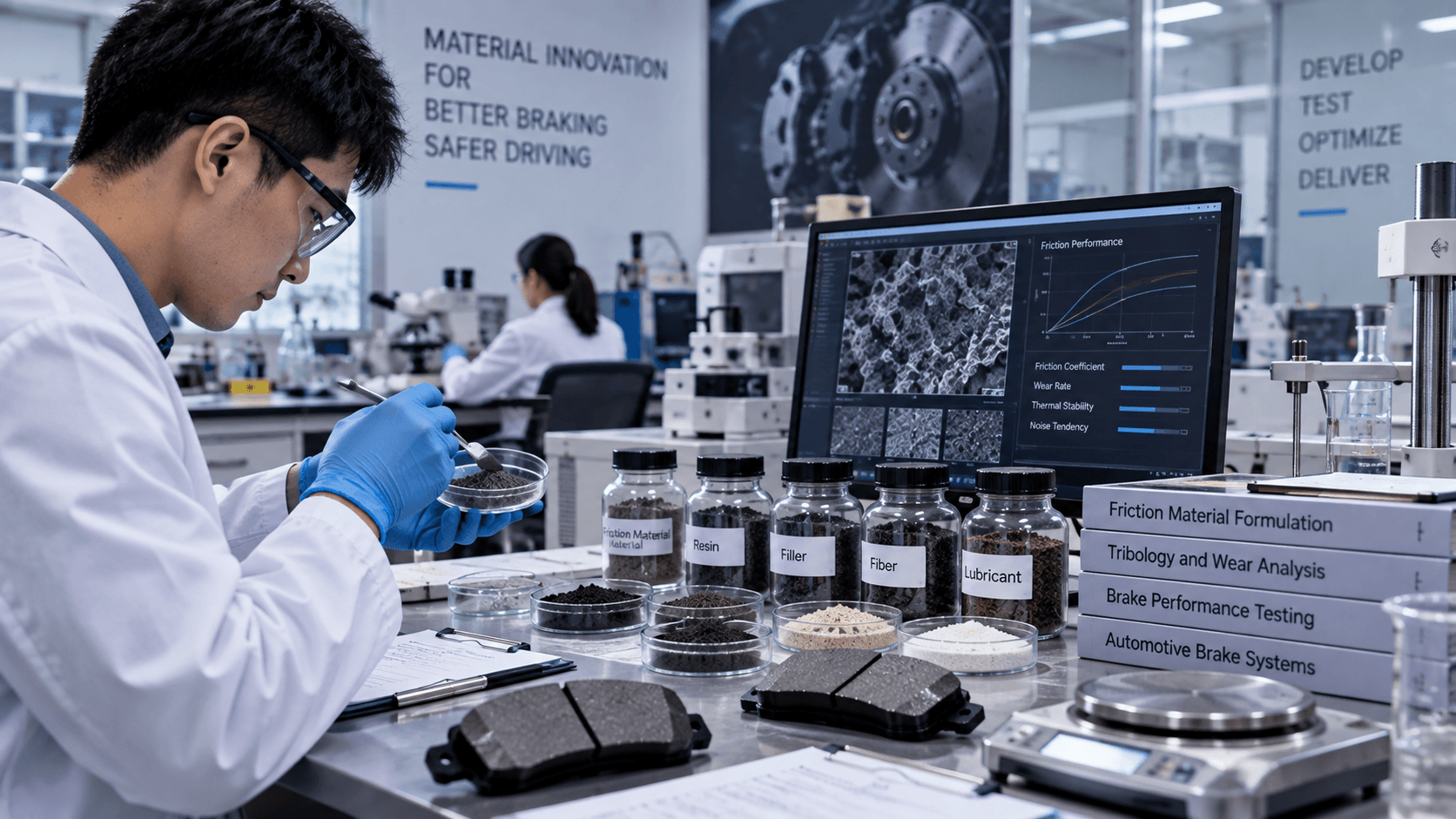
For brake pads intended for Europe and the United States, the formulation trend is not one universal material for both markets. The broader direction is to reduce restricted substances and address wear particles while preserving the braking performance, durability and comfort required by each project. Formulation is only one part of the work; market-specific validation determines whether the product can be supplied for its intended destination.
Trend 1: moving from low-copper to nearly copper-free friction materials
In parts of the United States, low-copper requirements are already a current compliance issue. California’s Department of Toxic Substances Control describes Level N brake friction material as containing no more than 0.5% copper by weight and explains the testing, third-party certification and marking associated with the 2025 stage. Washington’s Better Brakes Law likewise limits copper in pads and shoes manufactured after the 2025 date to less than 0.5%, with proof of certification required on products and packaging.
A buyer serving these markets therefore needs more than a supplier’s statement that a pad is copper-free. Confirm which friction formulation was evaluated, who performed the testing, which part numbers are covered by certification or registration, and how edge codes and packaging connect to the records. Low-copper development is a chain of material control, testing, certification and marking—not a color or marketing name.
Trend 2: Europe is addressing brake wear particles as well as tailpipe emissions
The European Union’s Euro 7 regulation brings brake systems and brake particle emissions into the vehicle-emissions framework. A 2026 delegated regulation then amended the conditions used to test compliance with brake particle emission limits by referring to UN Regulation No 179. The direction is clear: friction material development increasingly needs repeatable measurement and control of wear emissions alongside traditional performance targets.
Low particle emissions should not be interpreted as simply lowering friction or making a softer material. A formulation change can affect wear, temperature behavior, noise, vibration and interaction with the mating surface. Buyers should first define the vehicle category, application, destination and validation method, then compare the complete results of candidate formulations. European and US regulatory routes are different; evidence for one market does not automatically satisfy the other.
Why the trend is urgent
- Some requirements are already in effect: the 2025 low-copper stage in California and Washington is a present sourcing requirement, not a distant target.
- European testing is becoming more specific: Euro 7 and its subsequent testing provisions are turning brake particle emissions from a policy direction into an engineering validation task.
- Development starts before sales: material screening, samples, testing, customer approval, markings and inventory transitions all take time. Waiting for a customer question can miss the customer’s product schedule.
- Legacy evidence can be misleading: the same pad shape may have several formulations and market versions. An older report may not cover the current material or destination.
European and US programs need a formulation matrix, not one formula
For OEM and private label sourcing, a market-specific formulation matrix is more useful than a single green formula. Each row should identify the product or pad shape, material revision, destination, validation status, edge-code or label rule and available evidence. This lets the buyer separate products supported for relevant US low-copper requirements, products still requiring European particle-emission validation, and formulations intended for other destinations.
An RFQ should state the destination country or state, vehicle and application, reference numbers, forecast quantity, performance or testing documentation, and marking and packaging requirements. A useful supplier response distinguishes available evidence, additional validation and unresolved items instead of applying labels such as ceramic, green or low-dust to every technical difference.
Can Chinese OEM factories handle the transition?
China has an established friction-material manufacturing supply chain, but that does not mean every factory is fully qualified for every European or US program. A capable candidate should demonstrate four areas:
- Formulation control: separate material revisions by market and project, with controlled changes to formulations, raw materials and processes.
- Validation coordination: prepare identified samples, explain the scope of reports and coordinate with appropriate laboratories or certification bodies where required.
- Quality and traceability: connect products, material batches, edge codes, labels and shipment records so that changes and discrepancies can be investigated.
- Multi-SKU production: manage multiple pad shapes, formulations and private label packages with clear production and document controls.
The defensible conclusion is not that all Chinese factories can do this. Chinese manufacturers with formulation development, quality systems, validation coordination and traceability can be competitive partners for European and US brake pad programs, subject to verification by formulation, part number and destination.
Why BAOTAI is relevant to the evaluation
According to information currently published on the BAOTAI website, the company focuses on friction-material development and braking-product manufacturing. It supports OEM and private label coordination for pad shapes, formulations, markings and packaging, and displays information related to IATF 16949, ISO 9001, ISO 14001 and NSF Level N capabilities. These areas align with project needs for low-copper formulation control, mixed-SKU production, certification coordination and batch traceability.
That makes BAOTAI a suitable Chinese OEM candidate to enter the documentation, formulation selection, sample and validation-planning stages for European and US programs. Suitability for a particular destination still depends on current certificates or registrations, product-specific test results, customer requirements and applicable rules.
Review our OEM and private label services and brake pad catalog, then use the inquiry form to provide the destination, part references, volumes, formulation direction and documentation requirements for project-specific review.
Editorial note: This is an original BAOTAI industry observation. It does not provide formulation ratios, vehicle-fitment conclusions or a universal compliance guarantee. Regulations and certification requirements may change; buyers should verify current authority guidance, valid documentation and project evidence. The current cover is a placeholder pending replacement in the admin system.

