


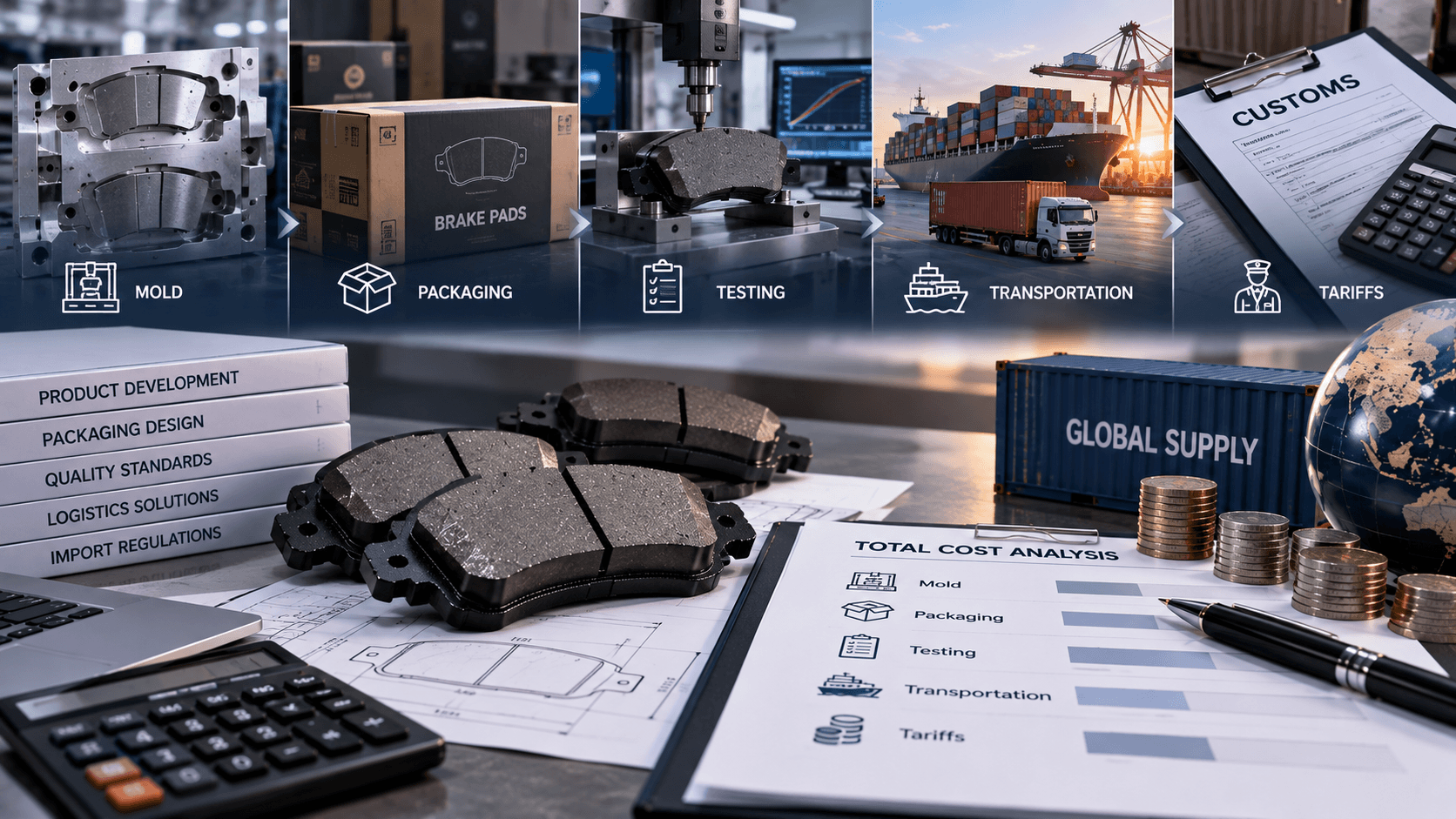
A factory quotation is only the starting point for a bulk brake pad import. Margin depends on the landed cost when goods reach the buyer’s warehouse in saleable condition. Comparing unit prices without aligning what each quotation includes can produce the wrong sourcing decision.
1. Product and development costs
Separate existing pad shapes from projects requiring development. Charges may include molds, tooling, samples, special accessories and engineering documents. Establish whether each cost is one-time or amortized, and document ownership, maintenance, useful life, modifications and disposition after the relationship ends. Paying a tooling charge does not automatically transfer every design or ownership right.
2. Packaging and brand costs
Private label programs may require color boxes, labels, cartons, inserts, barcodes, printing plates and artwork conversion. Check the MOQ for each material, expected waste, ownership of unused stock and revision costs. Mixed-SKU orders may add sorting, labeling and mixed-carton handling.
3. Testing, certification and documentation
Requirements vary by destination, customer and product revision. Define who selects the laboratory, who pays for initial and repeat testing, which formulations and part numbers a report covers, and whether changes trigger new validation. A quality management system certificate does not replace product testing or market-specific requirements.
4. Factory-side costs outside production
Quotations may also include inland transport, pallets, packaging treatments, storage, export clearance, documentation, loading and origin terminal handling. State the Incoterm, named place and edition, then identify each party’s cost and risk boundary.
5. International freight and insurance
When comparing full container, less-than-container and air freight, look beyond the main freight rate. LCL can bring origin and destination handling charges; FCL involves trucking, loading and demurrage exposure; air freight depends on chargeable weight. Add insurance, peak-season and fuel surcharges, inspection delays and exceptional storage to scenario budgets.
6. Duties, import taxes and customs value
Have an appropriately qualified customs professional confirm classification in the destination country, then check current duty, additional tariffs, VAT or sales tax. Trade.gov describes landed cost as including the original price, insurance, freight, tariffs, taxes and other fees. Its customs valuation guidance notes that packing, molds and certain buyer-supplied design or engineering values may affect customs value. Treatment depends on destination rules and should not be copied from another country or an old shipment.
7. Costs after arrival
- Customs brokerage, terminal charges, unloading and inland delivery;
- Receiving inspection, relabeling, warehouse allocation and system entry;
- Shortages, mixed parts, damage or document discrepancies;
- Working capital, currency movement, safety stock and slow-moving SKUs;
- Warranty, returns and quality investigations.
Build a comparable landed-cost sheet
Use the same fields for product value, one-time charges, packaging, testing, factory-side fees, international freight, insurance, taxes, customs clearance and warehouse delivery. Divide the total by saleable units. Model normal, higher-freight and delayed-sales scenarios so that an estimate is not mistaken for a fixed result.
How BAOTAI supports cost planning
BAOTAI can structure a project quotation around confirmed part numbers, volumes, formulation direction, branded packaging and delivery terms. Complete buyer data makes it easier to separate product pricing from tooling, packaging, samples and other conditional or one-time charges.
Start with the OEM RFQ checklist, then submit the destination, SKUs, volumes and preferred Incoterm through the inquiry form. Duties, taxes and destination charges should be verified with the buyer’s customs authority, broker and freight forwarder.
Editorial note: This original BAOTAI cost-planning guide is not tax, customs, legal, freight or quotation advice. The current cover is a placeholder pending replacement.

