


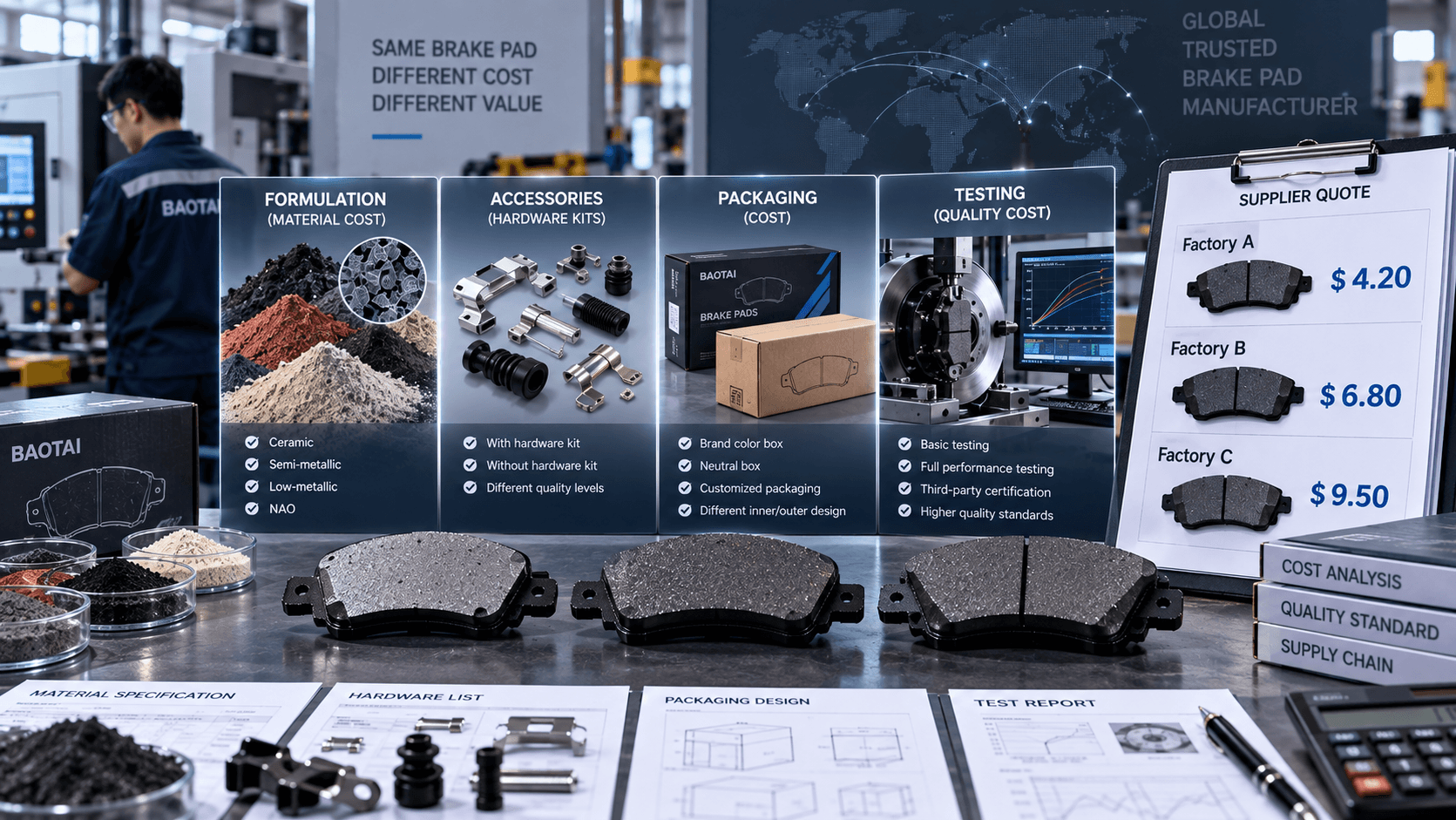
Two Chinese brake pad factories may quote noticeably different unit prices against the same list of reference numbers. The lower quote is not automatically inferior, and the higher quote is not automatically better. More often, the suppliers have priced different product revisions, hardware, packaging, testing and trade terms. Buyers should normalize the scope before negotiating the price.
1. Confirm the same pad shape and configuration
OE, FMSI and supplier cross-references help identify candidate products, but they do not establish that every dimension, backing plate, wear lead, shim, clip and other accessory is identical. The RFQ should state the customer SKU, references, key dimensions, axle position, hardware configuration and intended vehicle coverage, with unresolved items marked for confirmation.
2. Friction material changes the cost basis
The same pad shape can be offered with different friction material specifications. Raw-material systems, performance targets, destination requirements, validation scope and order volume can all affect cost. Broad labels such as ceramic, low-metallic or copper-free are not enough for a comparable quote. Ask the supplier to identify the controlled internal material specification behind the price and confirm that it will apply to samples and production.
3. List included hardware item by item
Some quotes cover the pads only; others include shims, wear sensors, clips, bolts or installation hardware. Material, quantity, assembly and sourcing of these items affect price. Add hardware fields beside every SKU rather than placing a general “hardware included” note at the bottom of the quotation.
4. Private-label packaging is not one fixed charge
Color boxes, labels, barcodes, instructions, wrapping, inserts and master cartons can each have an MOQ, printing setup or revision cost. A mixed-SKU order also adds sorting, labeling, leftover material and short-run packaging losses. State the sales unit, carton quantity, shipping marks, design responsibility, packaging MOQ and ownership of unused packaging. See our private-label packaging and traceability checklist for preparation details.
5. Testing and documentation depend on scope
Test reports, product approvals, customer-nominated laboratories, sample freight and retesting may be charged separately or amortized at an agreed volume. Confirm which pad shape, material revision and destination market each document covers. A management-system certificate does not replace the product or project evidence required for a particular order.
6. MOQ and order structure affect unit price
One high-volume SKU and hundreds of short-run SKUs require different changeover, material picking, labeling, packing and inspection work even when total sets are equal. Compare quotations using the same SKU count, quantity per SKU and expected annual demand. If pricing is based on total order volume, ask for the minimum per SKU and the price basis for replenishment orders.
7. Factory prices under different trade terms are not comparable
EXW, FOB and CIF allocate different costs and responsibilities. Trade.gov describes landed cost as including the original product price, insurance, freight, tariffs, taxes and other fees. Actual tariff treatment, valuation and charges must be checked with the destination customs authority, broker and current carrier quotation. Keep origin charges, ocean freight, insurance, destination charges and import taxes in separate fields instead of ranking unlike Incoterm prices in one column.
Build a normalized quotation sheet
For each SKU, record the product and material revision, hardware, branding, packaging, test documents, samples, MOQ, lead time, trade term, quote validity and exclusions. Separate one-time charges, product unit cost and estimated landed cost. Do not enter zero for an unresolved item; mark it as pending or excluded.
Define the quotation boundary with the factory
Organize your SKU list, destination market, material and performance requirements, hardware and packaging revisions, then submit them through our inquiry form or review BAOTAI’s OEM and private-label services. BAOTAI can discuss a product and production plan against the confirmed project scope. Final prices, documentation and delivery conditions remain subject to project verification and written agreement.

