


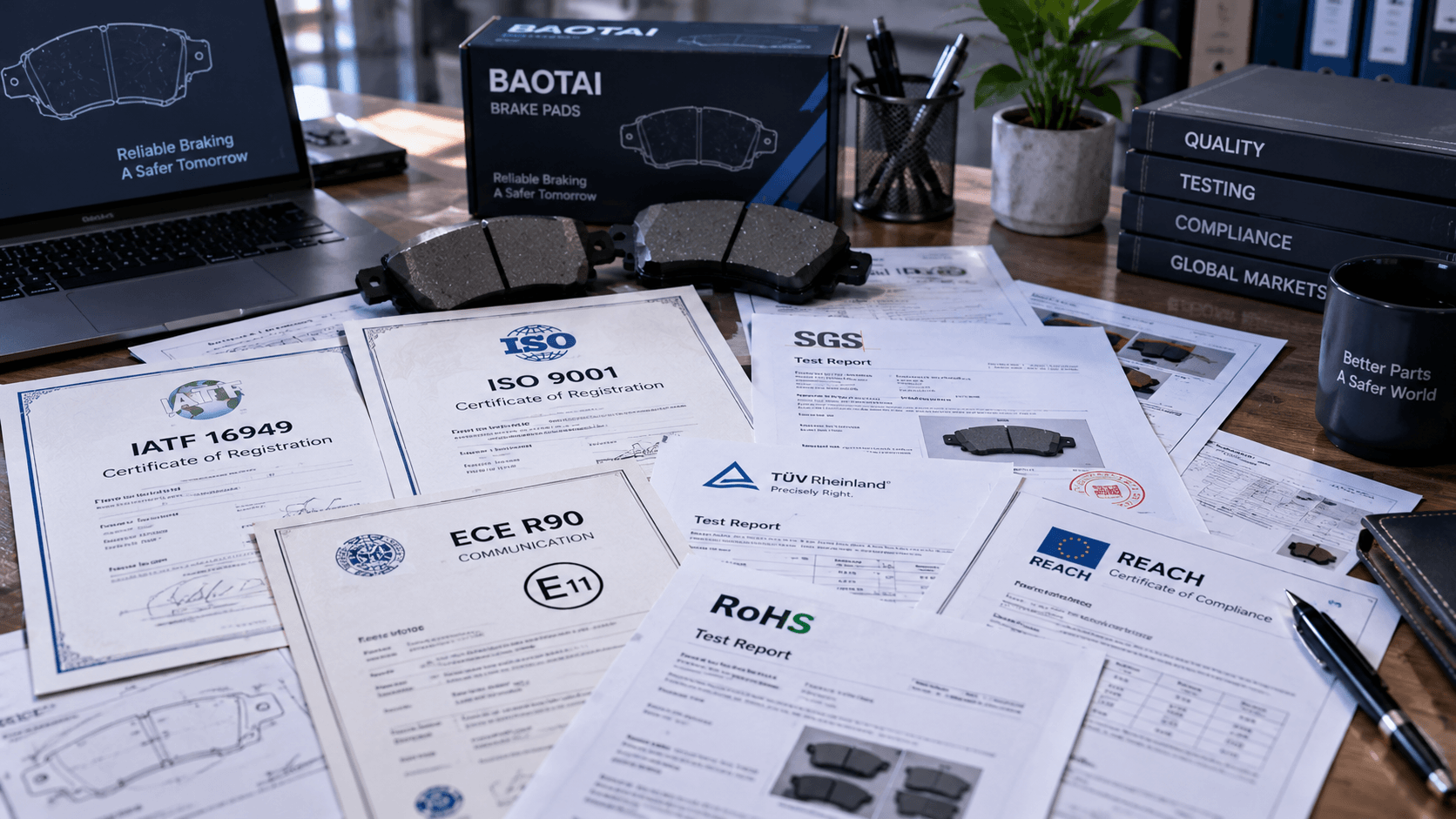
When auditing a brake pad supplier, buyers may receive scans of business registrations, management-system certificates, product approvals, test reports and inspection records. More documents do not automatically mean lower risk. The useful questions are what each document is, who issued it, whether it remains valid, what it covers and how it relates to the proposed product.
1. Work backward from destination and customer requirements
Requirements can differ by country, vehicle category, sales channel and customer contract. Build an applicability matrix first: identify regulatory or product approvals, customer-nominated tests, supplier-management requirements and internal purchasing evidence. Do not turn a document common in one region into a universal requirement.
2. Management-system certificates cover the management system
ISO describes ISO 9001 as a quality management system standard. ISO itself does not certify organizations; external certification bodies perform certification. Public ISO and IAF auditing guidance also explains that accredited ISO 9001 certification does not mean that the product itself is certified or that every item is guaranteed to conform.
Review the legal entity, manufacturing address, certification scope, full standard reference, certificate number, issue and expiry dates, certification body and accreditation information. If the scope covers only trading or sales, or the address differs from the production site, request an explanation rather than treating the cover page as proof of manufacturing capability.
3. Match product approvals to their scope
A product approval or regulatory document should identify the product type, approval number, holder, manufacturing location, marking and applicable vehicle or scope. UN Regulation No. 90, for example, addresses approval of replacement brake lining assemblies and related products. Whether it applies to a particular destination, vehicle and product must be checked against current destination requirements and the approval itself. One R90 document does not establish coverage of every supplier SKU or formulation.
4. Check sample identity before a test conclusion
Before reading passed or compliant, check the laboratory, report number, date, applicant, sample description, pad shape or part number, material revision, test method, results and assessment criteria. If the sample, formulation or dimensions cannot be linked to the current SKU, ask for the coverage rationale. Establish whether the file is the complete report or selected pages and whether the laboratory’s competence covers the reported work.
5. Quality records show how an order is controlled
Certificates and reports are often point-in-time evidence. Operational records can show how the supplier controls the order. Depending on project risk, review:
- Contract and technical review, drawing and specification revision control;
- Links between incoming batches, material specifications and work orders;
- Process parameters, equipment maintenance and measurement-equipment status;
- First-piece, in-process, final and packaging inspection records;
- Nonconforming-product control, corrective action and complaint closure;
- Traceability between finished batch, labels, carton numbers and shipment records.
Request only records relevant to contractual and risk needs and respect reasonable boundaries for confidential manufacturing information.
6. Verify documents rather than only collecting PDFs
Check certificate status through the issuing body or an applicable official channel, matching the entity, address, scope and dates. Product approvals and test reports may have issuer verification routes. A document that is not searchable online is not automatically invalid, but the supplier should provide a reasonable verification path. Edited documents, inconsistencies or refusal to explain should trigger deeper review.
7. Keep evidence aligned with samples and production revisions
Use the same customer SKU, supplier number, material specification and revision in the sample, order and shipment records. If material, construction, manufacturing location or intended scope changes, assess whether existing approvals and reports still apply. Do not attach a historical report indefinitely to every later product.
Build a supplier-document matrix
For each document, record its name, purpose, holder, issuer, number, revision, validity, covered address, covered product, verification date and owner. Statuses such as verified, pending, not applicable and expired are more useful than a simple yes/no column.
Prepare supplier-audit requirements
Organize the destination market, SKU list, required approvals and tests, sample stage and annual demand, then discuss them with BAOTAI through the inquiry form or review our manufacturing and quality control information. Certificates, reports, product coverage and quality records remain subject to the specific project, valid documents and verification by both parties.

